
By Angela M. Coggs
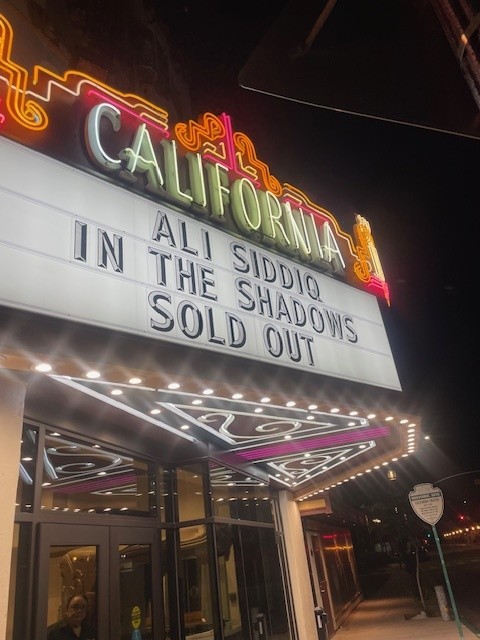
SAN BERNARDINO, CA— On a cool Friday evening in the heart of downtown San Bernardino, the historic California Theatre of the Performing Arts transformed into a sanctuary for storytelling. The marquee glowed brightly as a sold-out crowd filed into experience Ali Siddiq’s highly anticipated “In the Shadows Tour.” For a city that does not frequently land nationally touring comedians of this caliber, the moment felt both rare and monumental. And the community showed up.
After an amazing and stellar performance in front of a captivating audience, Siddiq hosted a Meet and Greet for what appeared to be over one hundred attendees who purchased the VIP experience. To observe the joy and smiles on the faces of everyone when they were greeted by Siddiq was like witnessing old school friends reuniting. He then graciously sat down in an empty theatre with this reporter for an in-depth and personal interview that gave the impression of a conversation between two friends reconnecting. Ali Siddiq is undoubtably a man of substance and the epitome of someone that is down-to-earth, genuine and sincere. What you see is what you get.
The event sold out. Residents from across the Inland Empire filled the historic theatre, demonstrating that there is both hunger and appreciation for high-caliber live entertainment in the region. The energy inside the venue reflected pride — pride in hosting the show and pride in supporting an artist whose work is rooted in authenticity.
“We appreciate you coming and bringing your presence here,’ said VIP audience member Patrica Cornish. “I hope others will follow your lead and bring other events here. This is a very intimate environment.”

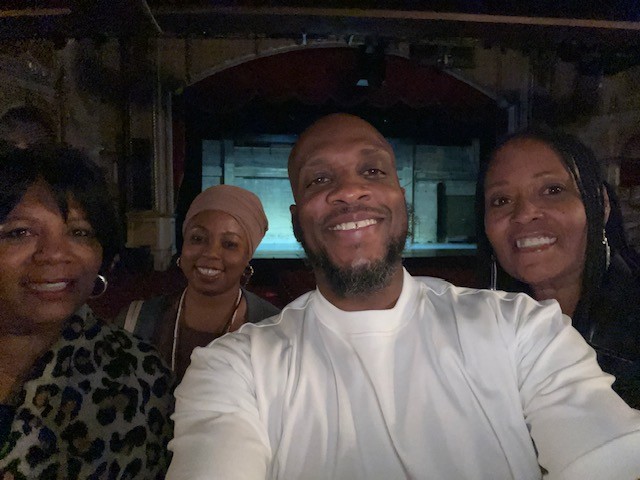
This reporter also took the opportunity to thank him for the rare stop to the historic California Theatre of the Performing Arts and his response was powerful. “That’s the reason we come. We go to a lot of places where people say no one comes here. If there’s a theatre there and people there, why not? This is a nice theatre and people are here,” acclaimed Siddiq. “Why have people travel to somewhere else when you can just come where they are?”
The evening was intentionally phone-free, with audience members securing their devices in Yondr pouches before taking their seats. In an era defined by scrolling, recording, and divided attention, Siddiq’s approach 1was deliberate. To fully grasp the nuance of his storytelling, one must listen — closely. Every pause, every inflection, every subtle shift in tone carries meaning.
Removing the distraction of cell phones did more than preserve the integrity of the performance; it elevated it. The audience was present — fully engaged, leaning into each narrative thread. The laughter came not in scattered bursts, but in waves — the kind that ripple through a room when everyone is listening at the same time.
Siddiq’s comedy is not a string of unrelated punchlines. It is architecture. The art of deconstructed reality. He builds his sets brick by brick, laying foundation with detail, layering context, and then — with surgical precision — delivering the release. He is not a fan of skits, and he does not do crowd work. He does not sit down and decide what stories to tell in his shows. Whatever mission he is on during a specific tour determines how he goes forward and which stories he tells.
He has developed a style of storytelling that draws the audience to him. He’s not in a rush.
His art lies in the deconstruction of real-life experiences into pure comedy. What might begin as a seemingly ordinary story unfolds into a carefully constructed narrative that disarms, educates, and entertains all at once. His style is straightforward, honest, and intentional. There is no frantic pacing, no reliance on shock value for the sake of reaction. Instead, Siddiq commands attention through patience and truth. “I haven’t written a joke in over seven years,” acclaimed Siddiq. He tells stories like the way his family tells stories. It’s a gift.
He challenges the widely held notion that audiences have short attention spans. “People don’t have short attention spans,” he has often expressed. “They watch what they want to watch — no matter how long it is.” On this night in San Bernardino, that belief proved true. The crowd remained locked in, following every beat of his extended stories, proving that substance still matters.
His shows have consistently drawn strong support from members of the Divine Nine and other Black Greek Organizations. When asked what that supports mean to him and how that community connection influences his journey as a performer, he stated, “they always come as fans. I do not promote to the members of Omega Psi Phi Fraternity, Inc. and do not want to be known as a “celebrity Bruh…. I’m just a Bruh. I don’t want anyone to think I joined Omega Psi Phi Fraternity, Inc. to increase ticket sales. I was already selling out.” That statement is absolutely true. He has been selling out at every tour stop, and some cases are adding second shows to accommodate the demand for tickets. It is significant for him to acknowledge and greet his fraternity brothers and brings them out to spend a few minutes to meet each individual member and deliver the proper Greek introduction.
Perhaps the most powerful throughline of the evening was Siddiq’s candid reflection on his life after incarceration. He spoke openly about his time in prison and, more importantly, about what came after. His journey of turning his life around was not framed as a dramatic reinvention, but as a conscious, steady decision to evolve.
“Not everyone gets the lesson when they are prison. Not everyone can make lemonade out of lemons. If they just take ownership of their actions, it would likely keep them out of prison, maybe that makes a difference. This is the reason you made it and others do not,” surmised Cornish. Siddiq wholeheartedly agreed, “I think that’s why people come to see me. The truth is in the bones. I make it hard for people…because when they see me, I do not make excuses.”
In his hands, even the most difficult chapters of his past become moments of levity — not to minimize them, but to humanize them. He does not glamorize his past. He reframes it.
Comedy becomes a vehicle for perspective — transforming pain into shared understanding and redemption woven into laughter.
That honesty resonates deeply. His delivery is direct, sometimes disarmingly so, yet it never feels careless. It is measured. Intentional. He tells the truth as he experienced it and trusts the audience to meet him there.
Siddiq keeps a down-to-earth tone with everything he does. He likes to stay independent when it comes to his performances, shows, tours, etc. He self-promotes and maintains responsibility for the logistics of his performances. When discussing the previously mentioned responsibilities, he simply said, “Heavy is the head that wears the crown.” The phrase has become an English idiom meaning that those charged with major responsibility carry a heavy burden that makes it difficult for them to relax. It’s one of the many misquotes from Shakespeare that make it into popular culture as rivals of Shakespeare’s own words. Siddiq finished his thought by stating, “sometimes it’s (the crown) heavy but it’s nothing I haven’t been through before.”
Ali Siddiq’s “In the Shadows Tour” is more than a comedy show; it is a masterclass in storytelling. Storytelling that stays with you. It requires attention. It rewards presence. It proves that laughter can be layered — that humor can coexist with reflection, and that redemption stories resonate most when told with clarity and courage.
Siddiq mentioned his new book called, “Applied Advice.” It’s a book of advice he received from 13 well-known personalities that have changed or influenced the trajectory of his actual being, Notable advice from D.L. Hugley, Sheryl Underwood, Billy Dee Washington, Bruce Bruce and BR Burns, to name a few, has made a difference in how he approaches things in life as well as on stage. Author and playwright B.R. Burns once told him, “Don’t ever get out of line, because as long as you’re in line, you will always get your opportunity. The day you get out of line, is the day you will never get your opportunity.” That quote reverberated with Siddiq and he proudly stated that he has never gotten out of line, no matter what he was going through or what position he was in. “I was grateful for what position I was in. A lot of people are not grateful for where they are standing at the time. They are just looking at what’s in front of them and never looking at who’s behind them because whatever that position is, someone wants that position now.”
For Siddiq to bring his tour to San Bernardino is virtually unheard of. Major tours often favor larger metropolitan markets, leaving mid-sized cities waiting on the sidelines. But on February 13, San Bernardino was not overlooked — it was center stage. And the city responded in kind. The interview did not end with a cold, shallow thank you and good-bye, it ended with a genuine thank you, I appreciate your time and a warm hug. He has set the bar high for others to follow.
On a night when distractions were silenced and the stage lights illuminated only the storyteller, San Bernardino witnessed something rare: comedy that does not rush, does not pander, and does not underestimate its audience. And judging by the standing ovation that closed the evening, the feeling was mutual.