



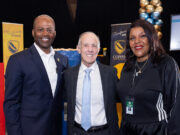











By Edward Henderson | California Black Media
Areva Martin is an award-winning civil rights attorney, talk show host, commentator, author, and keynote speaker who offers commentary on politics, women’s rights, children’s rights, disability rights and civil rights.
She is President and CEO of the Special Needs Network, which she founded to advance disability rights and support individuals across the autism spectrum, inspired in part by her experience as the parent of a child with autism
The Harvard Law School graduate also has her own firm in Beverly Hills, Martin & Martin LLP. In 2024, the firm secured a $27 million reparations settlement for Black and Brown residents in Palm Springs. That case now serves as a model and precedent for reparations efforts for descendants of slavery across California and around the United States.
Martin spoke with California Black Media about her successes and frustrations in 2025 along with her hopes for 2026.
Looking back at 2025, what stands out to you as your most important achievement and why?
In my nonprofit work, just recently, we led the charge in working with state agencies to create a new Medicaid benefit that will have implications for millions of individuals across the state of California.
Prior to this new benefit being created, if you were a foster care child in the state of California and you had behavioral health care needs, it was close to impossible for you to get behavioral health treatment because the agencies that provide that treatment were not able to register with Medicaid and become certified Medicaid providers.
So, my nonprofit, Special Needs Network, worked closely with several state agencies on raising awareness about this massive gap, this void. Then, we worked with them to become certified Medicaid providers so that those children who needed behavioral health treatment now have access to it.
How did your leadership, efforts and investments contribute to improving the lives of Black Californians in 2025?
My work in the media and my work as a civil rights lawyer and philanthropy has raised awareness about important challenges – like reparations, for example, a huge issue for Black Californians.
The historic win in Palm Springs is a model for the rest of the state. I’ve worked with some elected officials – including members of the California Legislative Black Caucus — to try to push through some of the reparations bills that came out of the statewide reparations study.
What frustrated you the most over the last year?
Looking at people who really believe that somehow a Trump administration was going to make their lives better. So. having to sit on our hands, and bite our tongues, not wanting to say to people, “I told you so,” but feeling like, “I really told you so.”
So, it’s a little frustrating because what do you say to those people? We’ve talked to them until we’re blue in the face. We’ve shown them the data. We’ve shown them the receipts. And sometimes even when we do all of that, they still resort to the talking points. They resort to the lies and the rhetoric in the right-wing media echo chambers. That can be very frustrating.
What inspired you the most over the last year?
I think seeing how deflated a lot of us on the Democratic side were, particularly Black women, after the election. I worked really hard on the presidential election. The dismantling of DEI, the attacks on civil rights statutes, the attacks on Black museums, and Black cultural institutions has been just really devastating. I think looking at how devastating some of these actions of this administration have been has really just motivated me to lift my voice, to stay in the fight.
What is one lesson you learned in 2025 that will inform your decision-making next year?
I think the biggest lesson is appreciating that there are people who you may work with, people who you may respect, but have very different opinions about where this country is, the direction of the country, where the city is, the city of Los Angeles, where the state of California is and recognizing the need to not write those people off.
To really be thoughtful and reflective about how you can still communicate with, do business with, and collaborate with these people.
In one word, what is the biggest challenge Black Californians faced in 2025?
Hostility.
What is the goal you want to achieve most in 2026?
I have two daughters that who graduated from law school this year and last year, and one has already been admitted to the California Bar. One is literally taking the California Bar as we speak. I’m working on some intergenerational projects with them.
One immediate project that we’re working on together is in the special needs network space, we are expanding. We have six offices now and we’re expanding into San Diego.