


















By Angela M. Coggs
SAN BERNARDINO, CA — The debate over commercial cannabis and its place within San Bernardino neighborhoods continued Wednesday, August 19, as residents, community advocates and city leaders gathered at Bing Wong Auditorium for a meeting of the San Bernardino Mayor and City Council.
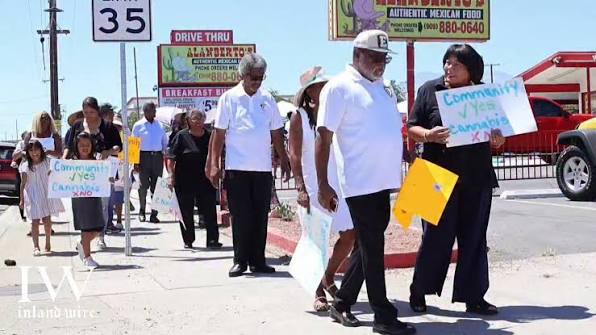
The meeting came just weeks after residents and community leaders gathered along Highland Avenue and Medical Center Drive for a rally opposing a proposed cannabis business near the Magnolia at Highland Senior Apartments. That August 2 demonstration brought residents into the streets in triple-digit heat, where they spent more than an hour making their concerns visible to passing motorists and city officials.
On August 19, the conversation moved from the street to City Hall.
The City’s official calendar confirms that the Mayor and City Council meeting was scheduled for August 19th at Bing Wong Auditorium, with closed session beginning at 4 p.m. and the public meeting beginning at 5 p.m.
For residents who had spent the previous weeks organizing, rallying, and encouraging one another to participate in the civic process, attending the council meeting represented another opportunity to make sure their concerns were placed before the officials responsible for regulating land use and commercial activity in the city.
From a Neighborhood Rally to City Hall
The concerns surrounding the proposed cannabis operation have become part of a larger conversation about how San Bernardino balances commercial development with the character and safety of established residential neighborhoods.
Residents associated with the Coalition of Westside & 6th Ward Citizens’, along with residents of Magnolia at Highland Senior Apartments, have argued that the location of a commercial cannabis operation deserves particularly careful scrutiny because of its proximity to residential housing.
The coalition’s August 2 rally was organized around the message, “Our Neighborhood. Our Families. Our Future.” Residents who attended the demonstration emphasized that their objections were focused on the proposed location and the potential effects on the surrounding neighborhood.
That distinction remained important as the issue reached City Hall.
The debate is not simply about whether cannabis is legal in California. It is about how a city regulates an industry that is legal under state law, where those businesses should be permitted to operate, what safeguards should be required and how much weight should be given to residents living immediately around a proposed location.
Those questions can become especially complicated when commercial cannabis operations are proposed near senior housing, residential properties, schools, churches, and other community institutions.
A Community That Has Continued to Organize
Among those who have been visible in the community’s efforts are longtime San Bernardino civic leaders Rikke Van Johnson, Kimberly Calvin, Cheryl Brown, and Dr. Gwen Dowdy-Rodgers, along with residents, faith leaders, neighborhood advocates, and other community members.
Johnson, a longtime San Bernardino community leader and former Sixth Ward City Council member, has remained active in local issues affecting residents.
Calvin, a former California Assemblywoman, and former Sixth Ward Councilwoman who is affectionately known throughout the community as “Mama Kim,” has likewise remained connected to neighborhood issues through her civic and community work.
Former Assemblywoman Cheryl Brown has also been identified among the community leaders supporting residents’ efforts.
Dr. Gwen Dowdy-Rodgers, who serves on the San Bernardino County Board of Education representing Area D, was also among the community leaders previously present with residents.
Their involvement underscores that the opposition surrounding the proposed cannabis location is not limited to a single group or a handful of individuals. It has attracted residents and people with long histories of civic engagement in San Bernardino.
The Coalition of Westside & 6th Ward Citizens’ has been particularly vocal in encouraging residents to participate in the governmental process and to make their concerns known through public meetings and other forms of civic engagement.
The Questions Behind the Cannabis Debate
At the center of the discussion is a fundamental question: What does responsible commercial development look like when a proposed business is located near an established residential community?
For residents opposing the proposed location, the concerns extend beyond the product being sold.
They include questions about traffic, parking, security, neighborhood activity, odor, property values, quality of life and the ability of seniors and families living nearby to feel comfortable in their own surroundings.
Those concerns are particularly significant for residents of Magnolia at Highland Senior Apartments, which organizers have identified as being extremely close to the proposed business location.
Community advocates have also raised questions about whether residents have received sufficient notification and whether the voices of people living closest to a proposed business are being adequately considered before approvals are granted.
On the other side of the debate, commercial cannabis businesses represent legitimate economic activity under California law. Cities that permit regulated cannabis operations can receive business-related revenue while businesses can create employment, occupy commercial space and generate economic activity.
San Bernardino’s challenge is determining how to capture those potential economic benefits while maintaining appropriate land-use protections and addressing legitimate neighborhood concerns.
Public Comment Puts Residents Directly in the Process
One of the most important aspects of a City Council meeting is the opportunity for members of the public to address their elected representatives.
For residents involved in the cannabis debate, that opportunity matters because public comments can place concerns directly into the governmental record.
The City’s published meeting materials specifically explain that residents wishing to address the Mayor and City Council must submit a speaker slip and follow the meeting’s public-comment procedures.
That process can seem routine, but for residents facing a decision that could affect the character of their neighborhood for years, appearing before elected officials can represent a significant act of civic participation.
It is also why community organizing matters.
The people who attended the August 2 rally, contacted neighbors, distributed information, and encouraged residents to attend City Council meetings were not simply protesting in the abstract. They were participating in the local governmental process.
Economic Development Versus Neighborhood Protection
The cannabis debate places San Bernardino officials in a difficult balancing position.
On one side is the economic argument. Commercial businesses can generate revenue, create jobs, and bring investment into the city. A workable regulatory system can also allow the city to exercise oversight over an industry that otherwise might be more difficult to regulate.
On the other side are residents who argue that economic development should not come at the expense of neighborhood stability.
Their argument is not necessarily that every cannabis business should be prohibited. Instead, many residents are asking whether every location is appropriate and whether the proximity of a proposed business to homes and senior housing should be given greater weight.
That distinction is critical.
A community can acknowledge that cannabis is legal while simultaneously asking whether a particular commercial operation belongs next to a residential neighborhood.
The Larger Issue: Who Gets a Voice?
The August 19 meeting represented more than another date on the City Council calendar.
It was another chapter in an increasingly organized conversation between San Bernardino residents and their local government.
The residents involved in the Highland Avenue and Medical Center Drive issue have repeatedly emphasized that they want to be heard.
Their August 2 rally demonstrated that commitment publicly. Residents stood outside for more than an hour in approximately 102-degree temperatures while passing motorists honked their horns in support.
The August 19 council meeting provided a different setting but carried the same underlying message: the community wants a seat at the table when decisions are made about its future.
For seniors living near the proposed location, the matter is deeply personal. For neighborhood advocates, it is an issue of land use and accountability. For community leaders, it represents another test of whether residents can effectively influence decisions made at City Hall.
And for the City Council, the issue requires weighing competing interests while considering the concerns of the people who live closest to the proposed operation.
What Happens Next?
As of August 20, the City’s publicly available calendar confirms the August 19 meeting and its scheduled format, but a complete searchable speaker-by-speaker transcript was not available in the indexed public materials reviewed for this article.
For that reason, specific statements made by individual residents, community organizations or council members should be attributed only after being verified against the official meeting recording or subsequently published minutes.
That distinction is important when reporting on a contentious local issue.
What can be said with certainty is that commercial cannabis remains a significant community issue in San Bernardino and that residents have demonstrated a willingness to participate in the process.
The debate also demonstrates that local government decisions are rarely just about ordinances, permits, or business applications. Behind every zoning question are people who live in the affected neighborhoods.
For the residents who have rallied, organized, and appeared before their elected officials, the message remains straightforward:
They want their neighborhood protected. They want their concerns considered. And they want to be heard before decisions affecting their homes and community are finalized.
As San Bernardino continues to navigate the future of commercial cannabis, the question will ultimately extend beyond whether businesses can operate in the city.
The larger question is where they should operate, under what conditions, and how much influence the people living closest to those businesses should have in determining the answer.