












Two-day event reveals new gains in graduation rates,
delves into new Student Success Framework and how the CSU is preparing students for an AI-driven world
Two-day event reveals new gains in graduation rates, delves into new Student Success Framework and how the CSU is preparing students for an AI-driven world
(Oct. 26, 2026) – The California State University (CSU) continues to raise persistence and graduation rates as it prepares students for an AI-driven workplace and adopts the new Student Success Framework, central to which is the CSU Promise to students that they will graduate with an opportunity for a job in their field of study or a clear path to graduate school.
The latest data show that more first-time students are graduating in four years, with the rate increasing 2.3 percentage points in the last year to 39.6%. The transfer student two-year graduation rate saw gains as well, up nearly 1 percentage point to 46.6%. Further, more students are staying on track, with 70.3% remaining enrolled or having graduated after three years.
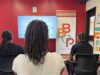
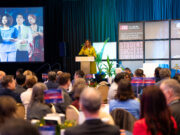
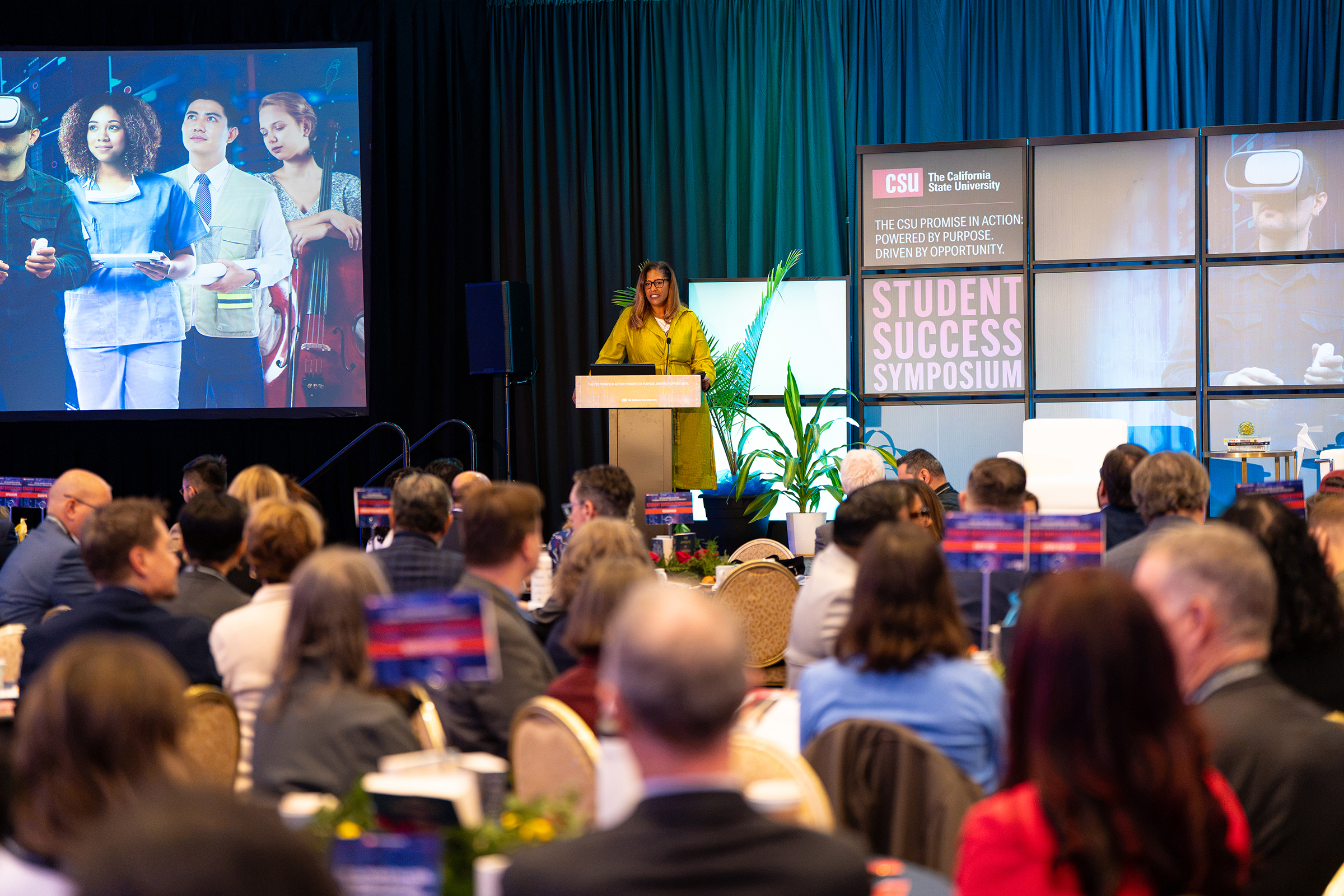
The graduation gains were shared at the Student Success Symposium, “The CSU Promise in Action: Powered by Purpose. Driven by Opportunity,” that took place Oct. 22 and 23 in San Jose. Emceed by CSU Student Trustee Carson Fajardo and attended by more than 300 student leaders, faculty, staff, presidents, system administrators and education partners, the symposium outlined the CSU’s commitment to expand career preparation opportunities and address the impact of AI on higher education.
The CSU announced its Student Success Framework last year following the culmination of Graduation Initiative 2025, the CSU’s decade-long effort to increase graduation rates and shorten the time it takes students to complete their studies. The CSU’s new framework expands how it defines and measures student success beyond retention and graduation to include affordability, experiential learning, career and graduate school placement, earnings and socioeconomic mobility.
“For the last decade, we have rightly asked how we help more students complete a degree,” said Dilcie Perez, the CSU’s vice chancellor for Strategic Enrollment Management and Student Success. “In this next era, we have to ask a larger question: what are our students graduating into?”
The symposium’s first day focused on career readiness and the workforce, with speakers and attendees in break-out sessions examining what students need to know, what experiences help them translate learning into opportunity, and how relationships, internships, professional networks and career-connected learning can help turn a degree into a path forward.
Amit Sevak, CEO of ETS, an assessment and skills solutions company that has partnered with the CSU to pilot FutureNav Compass, a career exploration and placement platform in support of the Student Success Framework, served as the keynote. He said the CSU has the potential to lead in this moment.
“The CSU Forward strategy and the student success initiative are, I think, going to really build a blueprint for access and opportunity across this country,” Sevak said. “[The CSU] is going to become THE American state university model because of what you’re doing…to help every student achieve their dream.”
Throughout the symposium, discussions surrounded how artificial intelligence is shaping higher education and the workforce and how the CSU, which launched its AI Strategy in 2025 can prepare students to use the technology effectively and ethically to augment─not replace ─human innovation and creativity and support their success.
One of the last sessions of the symposium was a recording of “My Robot Teacher,” a podcast on AI hosted by Sarah Senk and Taiyo Inoue, two Cal Poly, Solano Campus professors.
They spoke with David Goldberg and Elisa Sobo, professors at San Diego State who developed the CSU’s 2025 AI Survey, which was the largest survey of its kind looking at perceptions and use of AI in a university system.
The 2026 survey was recently conducted across the CSU, and during the podcast recording, Goldberg and Sobo shared that the latest survey saw an increase in respondents, exceeding 100,000. Early results show a continued high level of AI use, with more than 90% of those surveyed saying they use AI.
To end the symposium, Vice Chancellor Perez outlined next steps for the CSU in this final year before the Student Success Framework is fully implemented. By the end of November, campuses will complete goal setting, and in the next year the CSU will continue building programs, structures, policies, partnerships and practices. “By the time the fall 2027 cohort arrives, our work cannot live only in a framework, a presentation or a plan. It has to be visible in the student experience,” Perez said.