


















June is Black Music Month, a time to celebrate the artists whose creativity, innovation, and soul helped shape our nation. It’s also a good time to revisit some of the names that helped build that sound but have yet to be fully heard in their own right.
By Myshjua Allen Murray for WSS News, Arts, Entertainment & Culture
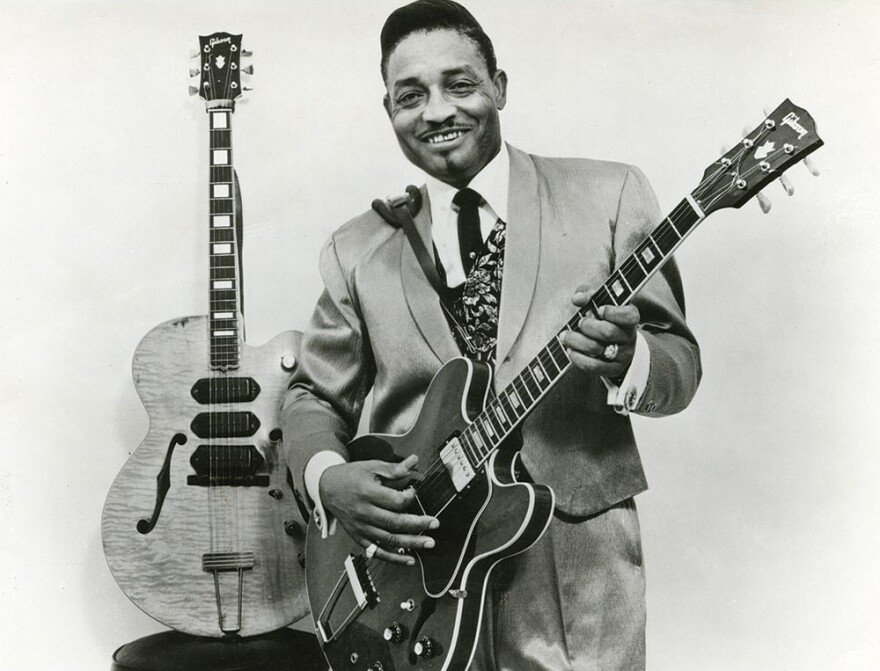
For forty years, Lowell Fulson has been Rock & Roll Hall of Fame adjacent.
When the Rock & Roll Hall of Fame inducted its inaugural class in 1986, Fulson already had direct connections to two of its members; Ray Charles and Elvis Presley.
To date, eleven Rock and Roll Hall of Fame inductees are less than six degrees of separation from Fulson:
- Ray Charles (Class of 1986) – In 1950, Lowell took the blind teenaged touring pianist into his band and under his wing.
- Elvis Presley (Class of 1986) – His 1960 version of “Reconsider Baby” is one of his most critically acclaimed performances. Lowell credits Presley with helping widen his own audience, telling writer/historian Howard DeWitt “He made our music more available to everyone. I played better clubs after Elvis sang my song.”
- B.B. King (Class of 1987)- A young B. B. King used to play Lowell’s records during his radio show in Memphis, TN. Fulson’s ‘uptown blues’ style inspired King. His first hit was a cover of “Three O’clock Blues”, and another Fulson classic, “Every Day I Get The Blues” became his theme song.
- Otis Redding (Class of 1989)- Scored a hit with his own rendition of “Tramp” featuring Carla Thomas.
- Ike & Tina Turner (Class of 1991)- Ike played with Fulson in his early years. In 1956, Ike and Tina Turner recoded their own version of “Reconsider Baby”
- Gregg Allman (Class of 1995)- Released his own version of “Reconsider Baby” on his solo project.
- Eric Clapton (Class of 2000)- Included Reconsider Baby and Sinner’s Prayer on his 1995 album From The Cradle.
- Prince (Class of 2004)- Used a sample from “Tramp” as the drum loop on his song “7” from the Love Symbol Album
- Salt-N-Pepa (Class of 2025)- Their first single “Tramp” heavily sampled both Fulson’s original record and the Otis Redding/Carla Thomas classic. Speaking of “Tramp”, this groundbreaking 1967 release has been sampled more than 50 times by artists including Ice Cube, Redman, Wu Tang, House of Pain, Cypress Hill, Grand Puba, and the aforementioned Rock Hall of Famers).
As Black Music Month inspires us to honor the artists who helped build American music, perhaps the question isn’t whether Lowell Fulson belongs in the Rock & Roll Hall of Fame.
Perhaps the better question is why we’ve waited this long to have the conversation.
How does an artist whose music helped shape blues, rock, soul, rhythm and blues, and hip-hop remain largely unknown outside of blues circles?
Born in Tulsa, Oklahoma in 1921, Lowell Fulson eventually found his way to California following his service in the U.S. Navy during World War II. Settling in Oakland in 1946, he became one of the pioneers of what would become known as West Coast Blues.
Unlike many artists who find a niche and stick with it, Fulson was constantly evolving. He blended blues with jazz influences, sophisticated horn arrangements, rhythm and blues, and contemporary sounds. His music remained rooted in the blues, but it never stood still.
His 1948 recording of “Three O’Clock Blues” became a foundational blues record. His 1954 hit “Reconsider Baby” spent fifteen weeks on the Billboard Rhythm & Blues chart and would later be selected by the Rock & Roll Hall of Fame as one of 500 Songs That Shaped Rock and Roll. A prolific writer and composer, his publishing catalog contains more than 200 registered works.
Like the blues itself, the legacy of Lowell Fulson is about more than one man’s story.
For most Black artists of the Jim Crow era, crossing racial divides at radio, retail, and media outlets required extraordinary circumstances and (often dubious alignments).
Many artists of the 1940s, 1950s, and 1960s helped craft the great American songbook while receiving only a fraction of the ownership opportunities and financial benefits enjoyed today. Their innovations became famous while the people behind them often remained in the background. The music often broke through. The names behind the music did not.
Lowell Fulson was highly respected by his peers. Deeply influential. Consistently working. Yet never fully embraced by the mainstream music industry in proportion to his impact.
Fulson continued to create, record, and perform throughout his life. He collaborated with the same artists that counted him among their musical influences. He wrote songs that became standards. He mentored younger musicians. He remained a sought-after performer on the global blues circuit until retiring for health reasons in 1997.
Lowell Fulson passed away in 1999 leaving a rich musical legacy. However, like many artists of his generation, that legacy was fragmented, unstructured, and thus unprepared for the massive music industry shifts that have taken place over the last 2 decades.
In this digital era of social media, YouTube, and streaming platforms, his music remains popular. Unfortunately, without the infrastructure necessary to organize, protect, and promote his catalog, unauthorized use of his art and name abound.
That is beginning to change.
Earlier this year, Fulson’s children assembled a team of experienced legacy catalog professionals to help preserve, protect, and celebrate their father’s life’s work. “My dad was a man of few words, and very humble,” says eldest daughter Yvonne Pena. “His voice was in that guitar and the pencil and paper that he kept writing songs with up to the day he died. I am happy to see that he lives on in the music he loved so much “
For fans, that means there is now an official home where they can learn about the man behind the music.
For historians, filmmakers, record labels, brands, and licensing partners, it means there is now a trusted source for information about Fulson’s life and work.
Learn more about how to connect with Lowell Fulson’s legacy on his official website, www.lowellfulson.com , and check out this week’s Black Music Month playlist: Black Music’s Unsung Architect: The Legacy of Lowell Fulson on our Youtube channel here